OpenAI GPT-5.4 mini
135 responsesRoyal Canin
Purina Pro Plan
Hill's
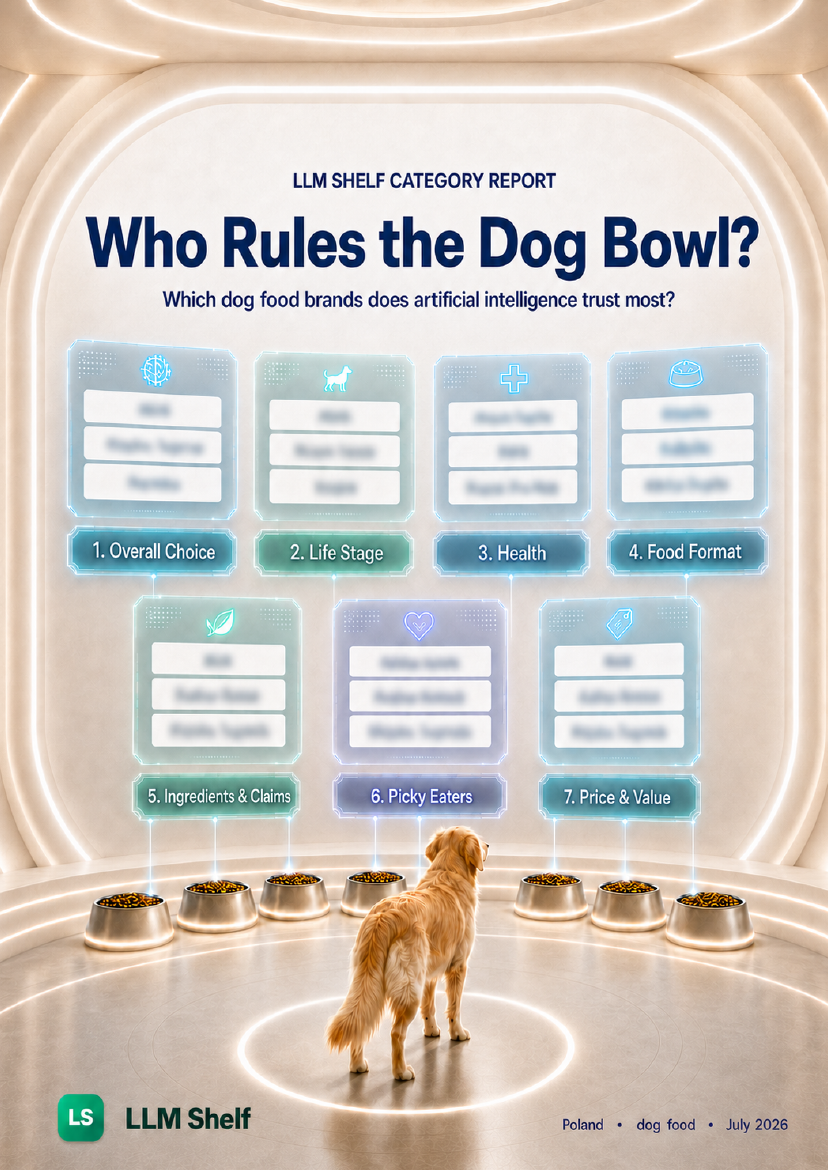
LLM Shelf report · Poland · July 2026
What does AI recommend to dog owners in Poland, and why does each system choose differently?
The complete, updated findings are available on this page. The downloadable English PDF is an executive summary.
The central finding
There is no single winner in AI visibility. A brand can be mentioned often yet rarely become the first choice. It can win in one system and nearly disappear in another, or dominate only for one specific need.
We measure brand presence, positive recommendation and first-position exposure separately.
Same question, different answer
Gemini and Google AI Overview named a specific brand in almost nine out of ten responses. OpenAI did so less often and more frequently stayed at the level of selection criteria. The brands each system favoured also differed.
In 80 cases every system named at least one brand. The same brand ranked first across all three systems only three times, or 3.8% of comparisons.
The same brand held first position in all three repetitions for 50.0% of Gemini prompts, but only 16.7% of OpenAI prompts and 16.0% of Google AI Overview prompts.
One category, seven winners
AI does not have one universal “best dog food.” As the need changes, so do the shortlist and the brand placed first.
| Need | Leader | 2nd | 3rd |
|---|---|---|---|
| Overall food choice | Brit - 59.3% | Wiejska Zagroda - 46.3% | Farmina - 37.0% |
| Dog profile and life stage | Brit - 59.0% | Royal Canin - 47.5% | Acana - 44.3% |
| Health and functional needs | Royal Canin - 69.1% | Hill's - 67.6% | Purina Pro Plan - 50.0% |
| Feeding format | Piesotto - 40.6% | PsiBufet - 36.2% | Micha Pupila - 30.4% |
| Ingredients and product claims | Brit - 25.9% | Wiejska Zagroda - 18.5% | Dolina Noteci - 16.7% |
| Picky eaters and acceptance | Alpha Spirit - 40.9% | Dolina Noteci - 36.4% | Wiejska Zagroda - 27.3% |
| Price and value | Dolina Noteci - 44.2% | Brit - 39.5% | Wiejska Zagroda - 23.3% |
Piesotto and PsiBufet sit outside the top tier of the overall ranking but move to the front when users ask about fresh or cooked food.
Health queries are dominated by brands associated with specialist diets: Royal Canin, Hill's and Purina Pro Plan.
The first answer is not the end
In 247 of 270 conversations with conversational models, a concrete recommendation appeared in the first response. The remaining 23 conversations received the same follow-up asking for specific products.
After the follow-up, a specific brand or product appeared in 261 of 270 conversations, or 96.7% overall.
Information ecosystem
Visible sources help describe the informational context of an answer, but the co-occurrence of a brand and a domain does not prove that the page caused the recommendation.
Manufacturer content is only part of the picture. Retailers, comparison sites, rankings and expert sources also matter. AI does not build recommendations solely from what a brand says about itself.
Accuracy review
Of 393 responses, 52 received a verification flag. A flag triggered further review; it did not automatically confirm an error.
Manual review found 16 cases in which an answer about feeding a dog recommended a product or variant intended for cats. In another 11 responses, the model correctly explained that the cat product was not intended for dogs.
What manufacturers can do now
The findings are not a simple ranking of food quality. They show how to design measurement and information so a brand can become a credible answer to a specific need.
An aggregate score can hide near-total absence in one model.
Entering a shortlist and opening that shortlist are two different advantages.
Content should explain the use case, limitations and credible evidence for product features.
Consistency and freshness should cover the manufacturer, retail, rankings and expert sources.
A follow-up can move the model from general criteria to a specific product shortlist.
Visibility can hurt when the system names the wrong product or uses an incorrect justification.
Methodology
The question set contained 45 prompts across seven need groups. Each prompt was run three times in Gemini 3.5 Flash, Google AI Overview and OpenAI GPT-5.4 mini, producing 405 tests.
Google did not display an AI Overview in 12 cases. We treated this as an exposure result for that surface, not a failed test. Content analysis covered 393 text responses. The normalised taxonomy contained 129 brands.
The share of responses in which a brand or product was presented as a positive, concrete choice for the user.
The share of all 393 text responses in which a brand appeared first in an ordered or reconstructable list.
The number of the seven need groups in which a brand was recommended.
A specific, positive recommendation of a brand or product appeared after the follow-up.
Study limitations
The report captures a specific moment. Models, interfaces, sources and indexes may change.
Conclusion
AI chooses a winner for a specific need, in a specific system, at a specific moment. For manufacturers, AI visibility is a decision map: it shows where a brand enters the shortlist, where it disappears, which arguments are attached to it and whether the recommendation remains accurate.
Where does your brand sit on this shelf?
Request an audit